
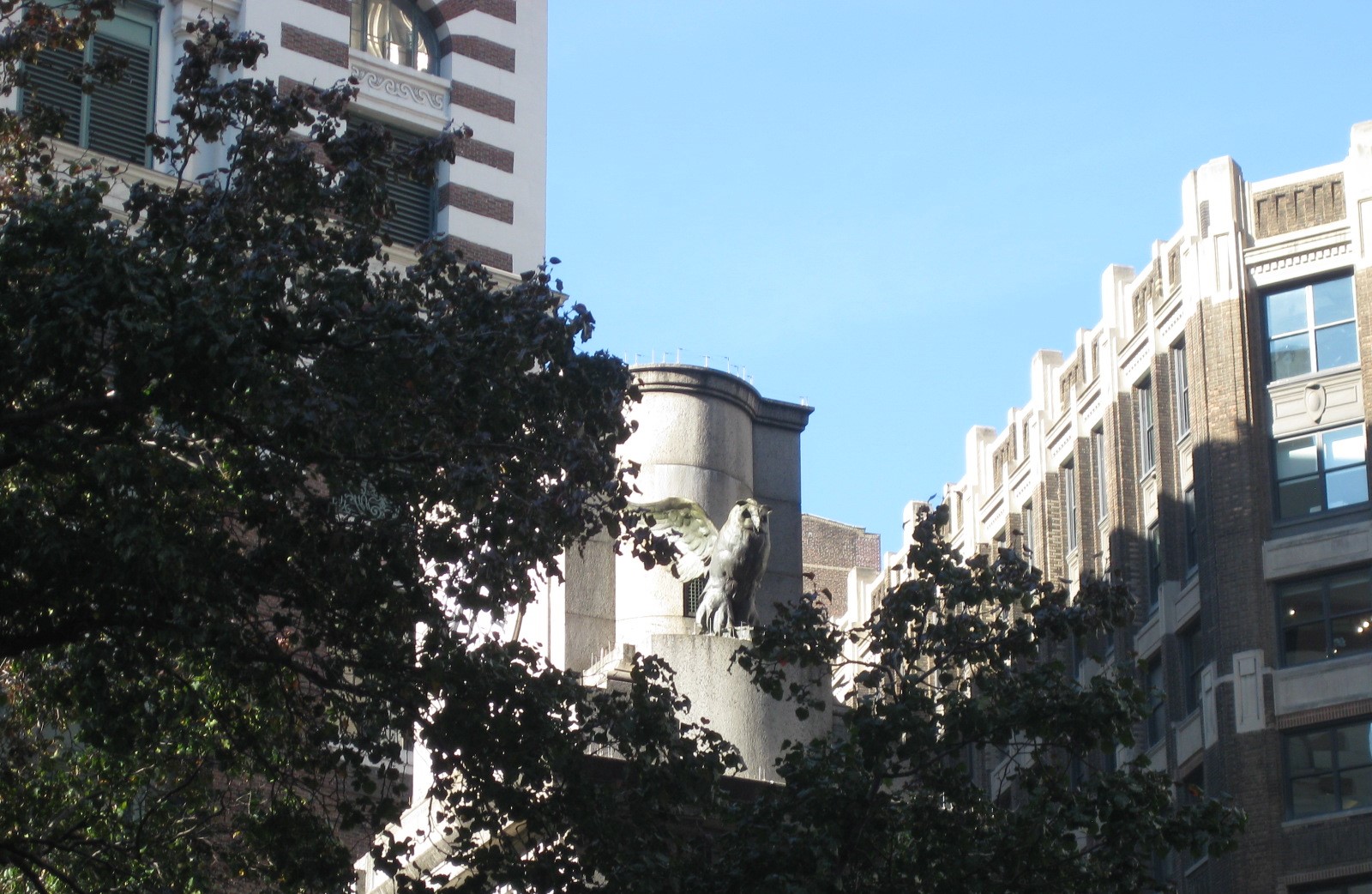
Herald Square is a triangular oasis in the middle of bustling Midtown Manhattan, nestled just east of the famous Macy’s flagship store. The square is often bustling with locals and tourists alike, drawn to its central location and lively energy. Yet, many people passing through may not realize the rich historical artifacts preserved within this park, a set of large bronze owls, striking bell, and statues with an intriguing backstory that connects them to New York’s journalistic past.
At the north side of Herald Square sits a distinctive granite apse structure adorned with a beautiful bell, flanked by an imposing statue of Minerva, the Roman goddess of wisdom, and two human figures with hammers. These figures and the iconic owls represent a piece of New York’s history, a reminder of the era when the New York Herald newspaper existed just north of the square.
The New York Herald and Its Original Home
Before the statues and owls found their place in Herald Square, they adorned the top of the New York Herald building, which once stood just north of the plaza where the current Santander Bank location, stretching up to 36th Street. This two-story palazzo-style building, a product of the famous architectural firm McKim, Mead, and White, was designed to resemble an Italian Renaissance loggia. The structure was completed in 1893, serving as a grand and monumental home for the New York Herald, one of the city’s leading newspapers at the time. However, the building was demolished in 1921, with only a few cherished elements, such as the statues and bell, salvaged and later installed in Herald Square.
The Herald building’s design featured classical and Renaissance elements, including its rooftop statues and architectural owls that have now become a defining characteristic of the current Herald Square monument. These owls not only represented wisdom, a nod to Minerva, but also served a practical function.
The Mysterious Owls and Their Glowing Eyes

In their original location atop the New York Herald building, the bronze owls were more than ornamental—they had glowing eyes that lit up the night. According to legend, these illuminated eyes served as a signal to passersby that the newspaper was in production, an intriguing detail in an era before modern advertising and electronic signs. When people saw the owls’ eyes gleaming in the darkness, they knew that inside the building, journalists were hard at work, ensuring that the news would be ready by morning.
This symbolic function of the owls was not just about the wisdom associated with the goddess Minerva, but also a creative way of showcasing the ceaseless flow of news in a rapidly growing metropolis. While the illuminated eyes are no longer operational today, the notion of these nocturnal creatures watching over the city remains powerful, adding to the mystique of Herald Square.
The Statues and the Bell: Preserving a Bygone Era
The granite-clad apse that houses the bell and statues in Herald Square is a beautiful homage to the original design of the Herald building. The bell itself is one of the most remarkable elements of this structure, featuring Minerva and two other human figures wielding hammers. These “bellringers” add a sense of movement and action to the monument, as though ready to strike the bell at any moment.
The bell and statues serve as reminders of the Herald’s place in New York’s newspaper industry during the late 19th and early 20th centuries. The addition of Minerva emphasizes wisdom and vigilance, fitting symbols for a newspaper that prides itself on delivering timely and important information. Minerva, along with the bellringers, underscores the idea that knowledge is hard-won and precious sentiment that resonates with the dedication and responsibility required in journalism.
Herald Square Today: Honoring History Amidst Modernity
Today, Herald Square stands as an eclectic blend of history and modernity, where pedestrians can relax in a lively urban setting while being surrounded by unique architectural details that whisper of the past. The large owls perched on either side of the bell seem to keep a watchful eye over the square, while the smaller owls mounted on granite-clad piers at the entrance add a touch of charm and continuity. The design and placement of these elements honor the original intent of the Herald building’s creators and allow visitors to experience a piece of historical architecture amidst the skyscrapers and traffic of modern New York City.
Though the glowing eyes of the owls and the tolling of the bell have faded into memory, the figures remain an enduring testament to the city’s journalistic history. The sculptures and owls bring a sense of dignity and reverence to the square, reminding New Yorkers of a time when newspapers were the pulse of the city’s heartbeat.